
CONTENTS
Obviously you already know what kitesurfing is and what this very particular sport involves. But before recounting the whole history of kitesurfing we need to define this extreme sport.
What is kitesurfing?
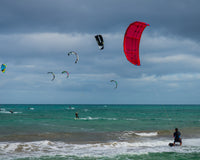
Kitesurfing is a sport that consists of gliding across the water on a board (also called a twintip) thanks to the pull of a kite. The wind drives a kite that pulls the kitesurfer along, as they're hooked into a harness (worn at the rider's waist). This connection (kite – body) lets you be pulled by the wind. In kitesurfing you don't just ride in a straight line: you can also do jumps and manoeuvres in the air. All this thanks to the connection between the kite and the harness worn at the waist by everyone who practises this sport.
Kitesurfing is an extreme sport. Yes, it is! And its history confirms it. Many people have suffered falls that have caused serious injuries, wounds and even death.
We class kiteboarding as an extreme sport because very high speeds are reached (higher than in windsurfing).
The harder the wind blows, the greater the speed and the bigger the jumps you can do.
That's why there are kitesurf professionals like Nick Jacobsen who seek out extreme weather conditions to set Guinness Records. Nick took the Guinness Record for the highest jump above sea level. This professional kiteboarder managed to fly 277 metres above sea level.
The beginnings of kitesurfing history
The term that gives this sport its name comes from merging Kite and surf.
The origins of this sport date back to 13th-century China, where kites were used to propel small vehicles.

There are no documented images, but let's say it would have looked like this photo, using a more rudimentary system.
In the 19th century, the Englishman George Pacock was looking for an alternative energy source to horses to power small carts and boats. It occurred to him that he could harness the power of the wind with kites; he carried out several tests and found that the invention worked.
Later, in 1903, aviation pioneer Samuel Cody, inspired by the eternal dream of flight, developed kites capable of pulling more weight and was able to cross the English Channel in a small folding canvas boat powered entirely by a kite.

The inventor of kitesurfing
In 1970, the Englishman Peter Powell built a two-line delta-shaped kite and sailed small boats with it. But it wasn't until 1977 that kitesurfing was invented, when Gijsbertus Adrianus Panhuise patented a system for riding a surfboard pulled by a parachute. However, this patent attracted no commercial interest at the time.


In the early 1980s, the Legaignoux brothers were already designing kites for kitesurfing. This French pair are considered undisputed pioneers and great promoters of the activity. They worked on its development over the following 10 years and managed to sell some 200 units made in France between 1993 and 1994 under the "WipiCat brand".

The film Upwind - Launch of a sport (History of kitesurfing) gives a very complete summary of the professional beginnings of kiteboarding.
The first commercial kite gear
In 1997 the first kites made by Neil Pryde, the leading windsurf sail manufacturer at the time, went on sale under the Wipika brand. Neil Pryde thus went down in kitesurfing history as the main seller of kitesurf gear. Thanks to this, the sport became much better known, as this manufacturer had a lot of influence in the shops and spots where windsurfing was most practised, especially Hawaii.

By 1998 the first licences were being sold and from then on more and more brands began developing in the kitesurf market. By the late 1990s there were also various specialist shops and schools teaching the sport around the world. That same year, the first major competition in kitesurfing history was organised in Maui, Hawaii. It was a friendly event they called the "Kitesurf World Championship”, attended by at least 25 of today's big names in kitesurfing.

The history of kitesurfing today.
In 2012 there were plans to include kitesurfing as an Olympic discipline in the Race format, similar to sailing regattas on a set course. However, after a vote by the ISAF General Assembly, it was decided to reinstate windsurfing.
By 2013 more than a dozen different kitesurf styles had been created, such as wave riding, freestyle, wakestyle, course racing, speed and downwinders, among others.
After years of struggle, it has been agreed that from 2024 kite foil Racing, also known as foilboard, will be a permanent Olympic discipline after its successful debut at the last Olympic Games in Paris.