
CONTENTS
- How long it takes to learn Paddle Surf
- Which Paddle Surf Board to Start With
- How to learn to Stand Up on a Paddle Surf Board
- How to learn to paddle in Paddle Surf
- How to place your hands on the paddle
- How to paddle correctly in Paddle surf
- How to go in a straight line in paddle surf
- How to go backwards in Paddle surf
- How to turn on a SUP
- Paddle Surf Equipment
Paddle surf has been the star summer sport of recent years, so learning paddle surf has become almost compulsory. Below you'll learn the basics of standing up on a SUP board so you can venture into this sport that fills the beaches with inflatable boards.
How long it takes to learn paddle surf
Time is a scarce resource: between studies, work, family and other obligations, we spend what little time we have relaxing. Learning a new sport like stand up paddle surf (SUP) takes a bit of time, but we promise that once you get the hang of it you'll be able to explore the best beaches for paddle surfing.
Learning paddle surf depends a lot on the individual; as you'll know, some people take to sport more easily than others. There's no magic formula that works for everyone. What I can tell you is that perseverance is the master key. The more you get in the water, the faster you'll learn paddle surf.
Falling is part of the journey. The important thing is to learn to fall safely, to avoid any nasty moments.
Which paddle surf board to start with
Choosing a paddle surf board is a crucial step in your journey to learn paddle surf. There are many types of paddle surf board, and it's important that you understand the differences between an inflatable and a hard paddle surf board.
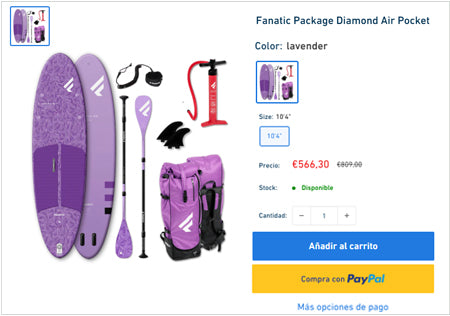
You should know there are mainly two types of paddle surf board: inflatable boards (easier to transport, as they can be deflated and folded) and hard boards (rigid boards that are harder to transport). Hard boards are for advanced users, so if you want to learn paddle surf, start with inflatable paddle surf packs. These are much cheaper and include everything you need to start learning.
Whether you decide to start paddle surfing on a hard board or an inflatable one, you should know there are several riding styles.
- Speed: Also known as Race boards; as the name suggests, they are paddle surf boards for racing. This type is only available as a hard board. You'll need to keep improving your paddle surf skills if you want to use competition boards, as they are only recommended for advanced users / pros.

- Long-distance touring: Special boards for long crossings. Ideal if you want to clock up the kilometres without dying in the attempt. With a more pointed nose, the board gets more speed for less paddling effort.

- All-round: Versatile boards are what we call allround paddle surf boards. With them you can paddle at beaches, on lakes and even in waves. With a rounded nose and a slightly wider shape, they give more stability. Allround boards are the most recommended for people learning paddle surf.

How to learn to stand up on the board
The mission of a paddle surf board is crystal clear! Basically, it's all about standing up on it and mastering it. But careful! Don't get overconfident: learning paddle surf can be more challenging than you think at first, unless you're a pro at keeping your balance.
So how do you launch into this adventure? First, carry your board to the water by the paddle board's central handle. Then place the paddle on top of the board and climb aboard! Start by kneeling in the middle of the board. Then slowly start to rise, putting one foot on the board and then the other, into a half-crouched pose.
Make sure your feet are shoulder-width apart, one on each side of the handle. Now keep rising, keep your knees slightly bent and keep your back straight at all times! And finally, point your toes forward, in the same direction you're looking! This, my water-loving friend, is the key to keeping your balance and learning paddle surf.

How to learn to paddle in Paddle Surf
Paddles are an essential part of any paddle surf kit. SUP paddles come in different sizes and shapes. It's very important that you know how to choose the paddle surf paddle that best suits your needs. If you're still learning, the paddle shouldn't worry you too much. The logical thing is to start with inflatable paddle surf packs, which contain everything you need to get started in the sport, including the paddle.
These paddle surf paddles are made of aluminium and are height-adjustable (ideal for beginners). Professionals, however, use carbon fibre paddles, which are much more expensive (but weigh less and deliver more power in the stroke).


How to place your hands on the paddle
Time to get into paddle surf like a real pro! And you know what, one of the key things in learning paddle surf is how to hold that paddle so you don't look like a beginner (although we all start there😜).
Here are the moves to blend in:
- Grab the "T"-shaped grip at the end of the paddle with one hand, and with the other, wrap your hand around the paddle shaft, the long part.
- Lift the paddle over your head, line it up with your shoulders and rest the long part of the paddle on your head.
- Hold on, don't let go! Without releasing the "T" grip, put your other hand on the shaft, forming roughly a 90-degree angle between your arms. That's the move for positioning your hands on the paddle while you stroke.
- Here's a trick: you can mark the spot with a piece of tape, so you're sure to grab the paddle quickly at exactly the right point.
- And with that, you're ready for action! Now you'll move with style on your paddle board, and nobody will guess you're a newbie.
How to paddle correctly
Hey, now that you've mastered where to put your hands in paddle surf, it's time to learn how to get around! I'm going to tell you how to move forward in a straight line and, of course, how to go into reverse too. Get ready to move across the water your way!

How to go in a straight line
Keeping a straight line isn't as hard as you think! You just have to give your SUP board a little push to move it through the water.

- If you want to go right and paddle in that direction, grab the paddle shaft with your right hand while your left takes hold of the grip at the top. If you decide to go left, just swap hands.
- To start moving, reach the paddle blade forward as far as you can (something like 60 cm). Then put the whole blade under the water and pull it towards your feet. The important thing here is to take the blade out right at that moment.
- Once you're in full rhythm, keep your arms almost straight and let your body lean slightly. And note: the pressure on the grip comes from your top hand, so don't wear out your lower arm. With this move, you'll get the most out of every stroke and make the most of your body's power.

That's it, you're on your way! Now all you have to do is enjoy the breeze and paddle in style on your paddle board.
How to go backwards in Paddle surf
Going into reverse in paddle surf doesn't just let you move backwards; it also lets you slow down, brake and even change direction.
Say you're paddling on the right. To retrace your path, simply push the paddle backwards and dip the wide part of the blade into the water near the back of your board. Make sure the paddle is fully submerged below the surface.
Much as when you go forward, stretch your arms out and twist your torso instead of using brute force with your arms. The idea is to let the turn come from that rotation of your waist.
And here's a fun fact: if you're going backwards on the right side of your board, you'll notice the tip or nose of the board swing to the right! But on the left side, it works the other way round! So you can reverse in style and give your paddle surf an original twist as you back up on the water!
How to turn on a SUP
The "sweep stroke" trick is the key to turning your paddle board, whether you're standing still or surfing waves!
First, bend your knees a bit more than usual, as if you were getting ready for an epic move! Lower your arms so the paddle's "T" grip is just below your shoulders. If you're paddling on the right, imagine you're waving with your right shoulder as you get ready to turn.
With the paddle ready for action, submerge it completely in the water, making sure it's perpendicular to the paddle surf board. Now comes the fun part: make a wide movement, as if you were drawing an arc from the nose to the tail of your board. As you do this, rotate your body and use the power of your legs and hips to put more force into the movement.
If you do this trick on the right side, your paddle board will swing round to the right in an amazing turn! And of course, if you do it on the left side, your board will move in the opposite direction! So, ready to turn and show off on the water? Give the sweep stroke a go and surf the waves in style!
Complete equipment needed for paddle surf
The right equipment is crucial to getting the most out of paddle surf. Discover the essentials you'll need:
- The Paddle Surf Board
- The Paddle
- The Leash
- Clothing and Protective Gear
- Paddle Surf board backpack
- Dry bag
- Pump for an inflatable Paddle Surf board